
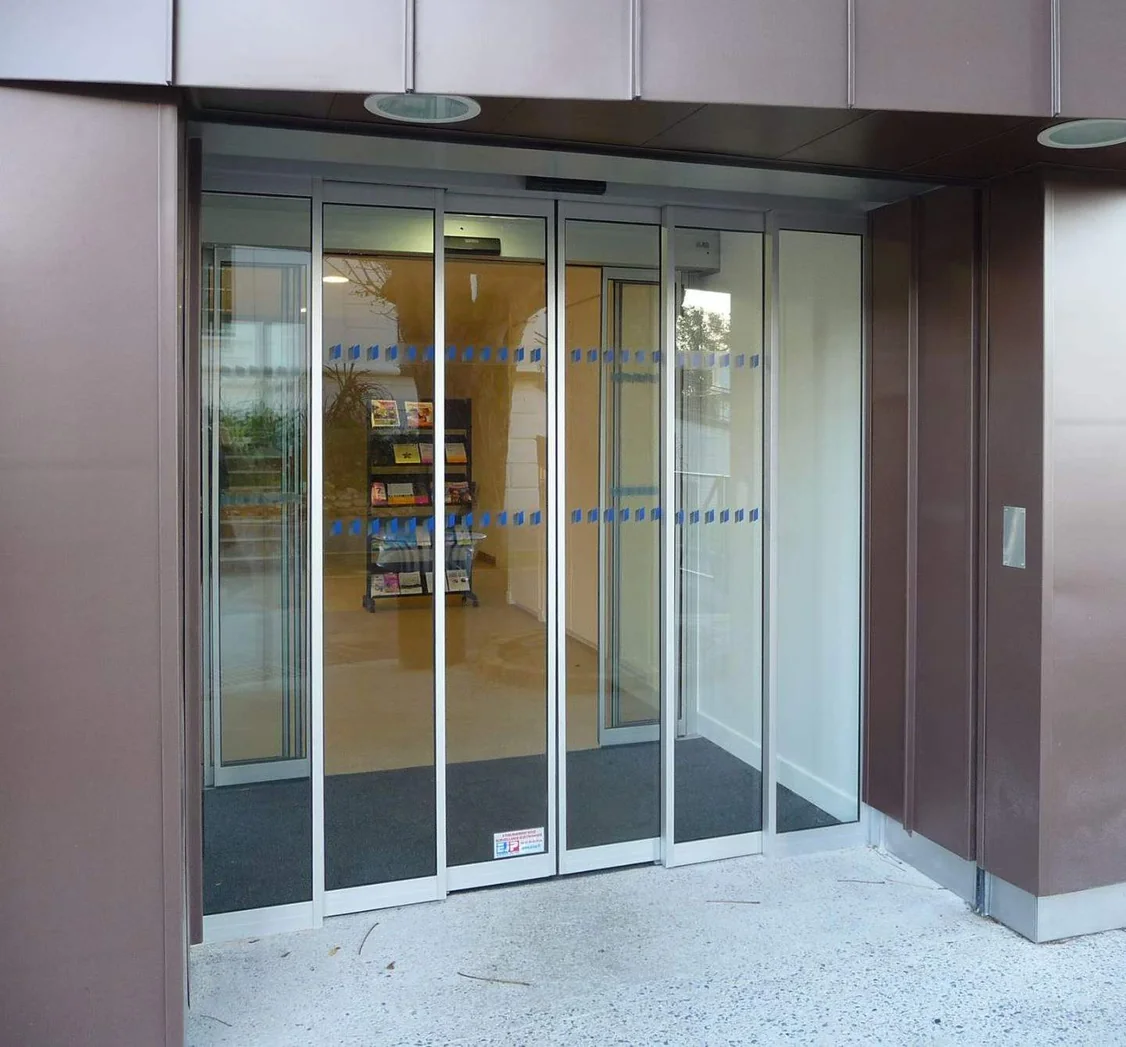
Single, bi-parting and telescopic layouts
A single moving leaf stores to one side. A single-track bi-parting layout moves two leaves away from the center. Multi-leaf or telescopic arrangements use linked leaves to create a wider clear opening within limited side storage. Labels such as 2+0, 3+1, 4+1, 5+1 or 5+0 are useful only after the drawing defines which leaves move, which remain fixed and where each leaf stores.
For kitchens, balconies, home passages, wardrobes or wine cabinets, the same geometry check applies on a smaller scale. Confirm handles, closing edges, furniture conflicts, cleaning access and the expected manual behavior during power loss.
Calculate space before discussing the operator
Mark the structural opening, target clear passage, moving-leaf widths, overlap, frame or frameless details, track length, service access and each leaf's closed and open position. A wide clear opening can require more storage length than the wall provides. A multi-leaf solution may help, but it also adds hangers, guides, synchronization and more closing edges to inspect.
Do not rely on a front photograph. A plan and elevation are needed to see the complete travel envelope and the relationship between the track, header, fixed panels and finishes.
Control and smart-building interfaces
The system may receive signals from presence sensors, push buttons, access-control terminals, smart modules, electric locks or a building fire interface. Each signal needs a defined electrical format and a defined priority. “Smart compatible” is not enough: identify whether the interface is a dry contact, voltage input, serial connection or another documented method.
Also define offline operation, network loss, access denial, hold-open timing, lock release, fire mode and power-loss response. A smart module should add a function without making safe local operation dependent on a cloud service.
Mechanical and commissioning checks
Before powered setup, confirm track alignment, support, hangers, mover or motor components, guides, end positions and free leaf travel according to the product instructions. During commissioning, keep the area controlled, verify sensing zones, learn or set travel with the actual leaf, and test obstruction behavior at appropriate low-risk stages.
Handover records should identify the offered model, controller and software or parameter version, operating modes, connected accessories and settings that the customer is allowed to change.
A practical selection worksheet
| Input | Why it matters | Document |
|---|---|---|
| Opening and storage | Determines leaf arrangement and track length | Plan and elevation |
| Finished leaf data | Affects drive, hangers and motion profile | Leaf schedule |
| Use scenario | Changes sensors, controls and duty | Operating sequence |
| Interfaces | Defines access, lock, smart and fire connections | Interface matrix |
| Site condition | Affects support, protection and installation method | Site photographs and survey |